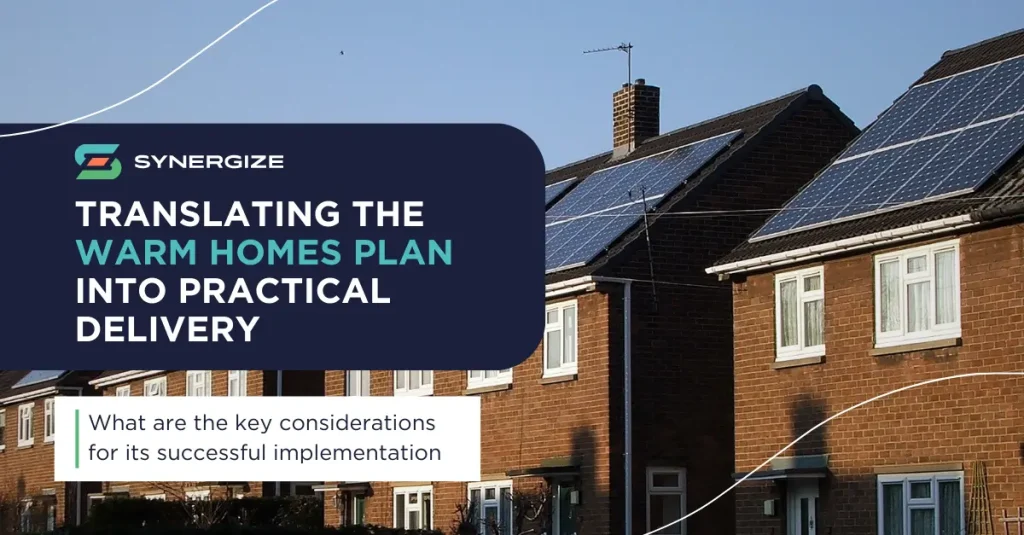
Translating the Warm Homes Plan into Practical Delivery
On 20 January 2026, the UK Government announced the Warm Homes Plan, a landmark commitment to improving the energy efficiency, comfort and affordability of homes across the country. With £15 billion of public investment pledged, the plan represents the largest home upgrade programme in British history and sets a clear strategic direction for tackling fuel poverty and reducing household energy costs.
As further details emerge and programmes start to take shape, attention naturally turns to how this national scheme will be translated into high-quality outcomes at a local level.
This paper offers a timely reflection on the Warm Homes Plan and explores the practical delivery considerations that will support its successful implementation.
What the Warm Homes Plan Sets Out
At its core, the plan is built around three mutually reinforcing goals:
Supporting Low-Income Households and Tackling Fuel Poverty
The Warm Homes Plan commits £15 billion to help families upgrade their homes with measures that improve energy performance and cut running costs.
Within that total a significant portion of funding is earmarked for direct support to low-income households and those in fuel poverty, offering upgrades that could be fully funded for eligible families depending on the most suitable solutions for their homes.
These may include insulation, solar panels, batteries and heat pumps technologies that will aim to enhance thermal comfort and energy efficiency.
The government’s aim is to lift up to 1 million families out of fuel poverty by 2030, helping reduce long-term energy costs while improving living conditions. This direct support builds on other recent measures to ease household energy costs, including earlier interventions that reduced average household energy bills.
Universal Access and Consumer Choice
The Warm Homes Plan also includes measures to make energy-saving and low-carbon technologies accessible to all households, not just those on low incomes.
Key elements include:
- Government-backed low and zero-interest loans that households can use to install technologies such as solar panels, batteries and heat pumps. This is intended to encourage wider uptake of clean energy solutions by reducing upfront cost barriers.
- A continuation and expansion of grants, such as £7,500 heat pump grants (including offers for air-to-air heat pumps that provide both heating and cooling).
- A broader financing framework that supports consumer choice and encourages households to adopt technologies in line with their needs and preferences.
Although the details and eligibility criteria for this scheme will be elaborated later in 2026, the inclusion of universal mechanisms shows an intention to support a wide range of property types and income levels.
New Protections and Standards for Renters
The plan also recognises the scale of energy inefficiency within rented housing.
Government figures highlight that 1.6 million children currently live in cold, damp or mould-affected private rented homes, underlining the need for action across all tenures.
The Warm Homes Plan therefore includes:
- strengthened protections for renters
- clearer expectations for landlords to invest in energy efficiency improvements over a fair transition period
These measures are intended to improve housing quality and help lift hundreds of thousands of renting households out of fuel poverty by the end of the decade.
What Happens Next – Key Factors for Successful Delivery
With the policy direction now set, the next phase will focus on programme design, mobilisation and delivery.
A national programme of this scale naturally raises questions about how outcomes will be realised in practice. Clear objectives are an essential first step, but consistency and quality considerations are equally important.
Three areas that stand out are:
Early Understanding of Buildings and Context
Accurate insight into buildings’ condition, performance and use will help ensure that upgrades are appropriate, proportionate and above all effective.
Clear Governance and Compliance Pathways
Well-defined responsibilities and quality frameworks will be key to supporting consistency and assurance as programmes scale.
Resident-Centred Planning
Clear communication and engagement will help build trust, enabling access and supporting smoother delivery in occupied homes.
Supporting Delivery Through Collaboration
The scale of the Warm Homes Plan reinforces the importance of collaboration across the whole sector.
- Government sets policy intent and funding frameworks
- Local authorities and housing providers provide local insight and strategic oversight
- Delivery partners contribute technical expertise, delivery capability and experience of working in live environments
Aligned working across these groups will help translate ambition into outcomes that reflect both policy objectives and community needs.
Quality as a Foundation for Confidence
As programmes move from planning into delivery, maintaining quality and consistency becomes increasingly important.
To support this the following foundational elements will play a key part:
- robust building assessment and diagnostic processes
- compliance with relevant safety, performance and quality standards
- integrated sequencing of works
- transparent documentation and reporting
This will help manage risk and maintain confidence among clients and residents.
Delivering Long-Term Value
When delivered with care and coordination, a home upgrades programme of this scale will result is lasting benefits including:
- lower energy bills
- improved thermal comfort
- healthier internal environments
- stronger, more resilient housing assets
These outcomes sit at the heart of the Warm Homes Plan’s ambition and will depend on effective delivery as much as funding and policy intent.
The Warm Homes Plan sets an important new direction for improving homes across the UK. As delivery frameworks begin to form, a shared focus on planning, collaboration and quality will be key to realising its potential.
By supporting compliant and resident-focused delivery, the sector can help ensure this investment delivers meaningful outcomes for households, communities and the housing stock they rely on.
We look forward to working alongside partners across the sector as delivery of the Warm Homes Plan progresses.